.svg)
.webp)
Twenty-five questions exploring the mind and habits of an artist.

At what age did you decide to become an artist?
Some of my earliest memories involve sitting in a high chair with a cartoon activity book, drawing characters, and solving visual puzzles. At the age of five, I asked for a professional drawing pad for my birthday, and subsequently, had an art fair on our front lawn. I don’t believe there were any sales. But it was at the age of eight that I asked for a Jon Gnagy Learn to Draw Set for Christmas, as I had seen his program on TV. For days I did nothing but plow through the lessons. By the end of the holiday break, I announced to the world that I was going to be an artist.
How did your parents react when you told them you wanted to be an artist?
They were quite supportive, but my father invoked a phrase many a young artist has heard: “You’re going to need something to fall back on.” I promised him that I would and spent my first year of art school studying graphic design, a field with which I was familiar, having checked out my share of books on the subject from childhood on while perusing the art stacks at the local library. I felt I learned enough about design from that single year and that I needed to spend the rest of my education studying painting, so I came out to Philadelphia to attend the Pennsylvania Academy of the Fine Arts.
Who are your favorite artists?
I admire the work of so many artists that even a short list would be difficult to compile. My late teacher, Sidney Goodman, changed my perception of what contemporary figurative painting could be. Among living painters, it’s Antonio Lopez Garcia, hands down. I think my fellow PAFA alumnus, Vincent Desiderio, is brilliant, as is his teaching cohort, Bernardo Siciliano. Catherine Murphy’s paintings are poetry. Beyond them, Jenny Saville, Wayne Thiebaud, Richard Diebenkorn, Fairfield Porter, Lennart Anderson, Edwin Dickinson, Balthus, Degas, Abbott Handerson Thayer. I’ve always felt a special kinship with Edward Hopper. Norman Rockwell was my first hero, and I still love and respect him. Andrew Wyeth was my principal early influence, and a dangerous one, as my work greatly resembled his for some time. I would meet him at nineteen and spend a day at the studio and compound with some fellow students, where we would see some of the infamous Helga paintings, ten years before the public would. (He told us his wife hadn’t even seen them yet.) His best advice to me that day was not to try to be him. Years later, a painting I posed for would hang on a wall in his home.
Who is your favorite artist whose work is unlike your own?
I developed a fondness for Robert Rauschenberg in my childhood, but I believe I was drawn to the figurative imagery he employed alongside abstract expressionism. He was having his cake and eating it, too. I love William Kentridge. Few people in recent history have created work in such a variety of media, with critical social and political messages attached. Yet, he’s not afraid to display a sense of humor. Anselm Kiefer. Willem de Kooning. Jennifer Bartlett. There are so many I could name, spanning a wide variety of styles. And as a recipient of a Pollock-Krasner grant, I have a soft spot for both of them.
Art book you cannot live without?
I actually read Ralph Mayer’s Materials and Techniques for the Artist cover to cover in my youth. Peck’s Atlas of Human Anatomy for the Artist was invaluable. Then there are the first two pocket books on artists that my mother purchased at the Art Institute of Chicago, thus beginning my art library, which I’ll always treasure.
What is the quality you most admire in an artist?
The human quality I admire most is humility, which is sometimes lacking in this art world. The formal quality I most appreciate in an artist is the ability to grow and change, rather than churn out the same work year after year, tempting as it may be.
Do you keep a sketchbook?
Yes. Besides a couple of newer ones I use, I often grab sketchbooks that go back as far as my art school days, which have some blank pages. Looking through them, I’m transported across a vast span of my life. Nearly all the drawings within them were done in the field, be they two-minute sketches or hours-long studies, every one conjures recollections of those days and places and people that photography never could.
What’s your favorite museum in the world?
While I have only seen a fraction of the museums I would like to visit, there’s no question that the Met is one of the greatest museums in the world. I feel fortunate to have lived in New York for the last twelve years, in that I can visit it often. A close second would be Paris’s Musée d’Orsay, dedicated as it is to the moment that painting began to change radically. It also holds a place in my heart, as I was in that museum when I decided, at the age of thirty, to leave graphic design and paint full-time.
What’s the best exhibition you have ever attended?
Choosing a best exhibition is a challenge, but seeing the Sidney Goodman retrospective at the Pennsylvania State University Museum of Art at the age of twenty-three changed my goals as a painter. As a nineteen-year-old, then worshipping Andrew Wyeth, the Met retrospective exposed me to originals I had been examining only in books for over a decade. Perhaps the most interesting show I’ve ever seen was Unfinished: Thoughts Left Visible at the Met Breuer. To see the working processes of so many artists, usually buried under successive layers of paint, was a rare treat.
If you were not an artist, what would you be?
I’ve been a lifelong musician and currently run the Brooklyn Jam Collective, so I may have gone in that direction were it not for painting. I briefly considered pursuing a career in music in my youth, but I couldn’t envision a world where aging guitarists were still playing. Little did I know. In the end, I knew I was a better painter than musician. The profession I’ve admired most is that of the writer, in every flavor. Beautifully crafting thoughts into delectable sentences, woven into even a short article, much less a thick tome, is a poetic skill as much as it is a powerful weapon.
Did you have an artistic cohort that influenced your early creative development?
As a child in a small city, I had no artistic cohorts my own age. My adult library card, awarded to me at the age of eight (rather than the usual twelve), allowed me to bring home as many books as I could carry, and they would be my earliest art education. By thirteen or so, I was taking adult classes at our local art center and would get close to their faculty, composed of talented painters who were commercial artists by day and fine artists by night.
What is one thing you didn’t learn in art school that you wish you had?
Many artists answer this question the same way: that they wish they had learned more about the business side of the art world. About what awaits them in the wilds of the gallery system, and how to discuss their work. How to promote it. At PAFA, both faculty and fellow students would admonish you if you even hinted at a concern about making a living after art school. To discuss it was verboten, blasphemy. There was a great deal of magical thinking going on, believing that the universe would simply provide.
What work of art have you looked at most and why?
Nighthawks is indelibly etched into my retinas. Perhaps because, like the Mona Lisa, we see it everywhere. But for me, it’s not just about Hopper, nor all of the formal and psychological analysis that this masterpiece has wrought. For me, it’s a painting that says New York, with more than a touch of noir, at a very specific time in its history. My childhood dream was to live here, and seeing it for the first time at ten or eleven years old, it immediately became the iconographic symbol of this city for me.
What is your secret visual pleasure outside of art?
Looking at every moment of every day with a painter’s eye, and if I’m with someone, sharing an especially striking visual, interrupting any conversation to point it out. A trait that’s not always appreciated. Yet teaching others to see, to look harder, whether in the course of teaching or simply among my circle of friends and family, is one of my greatest pleasures.
Do you listen to music in your studio?
I listen to a wide variety of music while I work. I also listen to podcasts, artist and author lectures on YouTube, old movies, stand-up comedy, or if I need an especially energizing boost, episodes of 30 Rock. But often I’ll work in silence, mixed with the sounds of my usually quiet street in Brooklyn.
What is the last gallery you visited?
Equity Gallery for the last days of Melanie Vote’s fantastic show. I’d admired her work going back many years before I met her, and she’s only getting better. If there’s a painter in my acquaintance who deserves blue chip gallery representation, it’s her.
Who is an underrated artist that people should be looking at?
I never miss an opportunity to make people aware of Sidney Goodman. Though he was collected by every major museum and showed in important exhibitions in his lifetime, he never achieved great fame, having eschewed the New York art scene, preferring his native Philadelphia, where he would spend his life teaching and influencing a generation of painters. He’s a bit dark for many, as is another painter I love, who has spent his career somewhat under appreciated, Jerome Witkin. Subject matter aside, I find them both to be expressive and painterly painters and master draftsmen. Going back a century or so, I feel that Abbott Handerson Thayer has never received his due. He could handle paint better than Sargent. And many of the artists in these interviews reply “themselves.” Humility aside, I’d be remiss not to echo that sentiment.
What art materials can you not live without?
Besides the obvious paint, brushes, and surface upon which to use them, I am always on the hunt for good watercolor paper, which is becoming more and more scarce. As a painter who works a great deal in that medium, there is no item more critical.
Do you paint/sculpt/create art every day?
I try, but far too many days find me at least partially engaged in other activities that may preclude me from doing so. But even if it’s a small amount of time, I do my best to do something daily.
What is the longest time you went without creating art?
The year I turned forty, I was diagnosed with cancer and didn’t have health insurance. I bought a computer and reluctantly returned to graphic design, a field I had left ten years prior. While I occasionally drew, I wouldn’t pick up a brush for four years. Yet I did do a great deal of non-commercial work in Photoshop during that period, exploring that medium as a painter might. Eventually, a commission from a long-time client allowed me to return to painting, which I’ve consistently done since.
What do you do when you are feeling uninspired?
The word “inspiration” has different meanings for people. To me, it’s a brief spark that occurs when an idea comes to me, or suddenly seeing something that makes me have to paint it. But once I choose to follow that initial inspiration, it becomes a job I need to complete. I have a quote on my wall by Howard Pyle: “Young people, don’t get the idea that you have an artistic temperament which must be humored. Don’t believe you cannot do good work unless you feel in the mood for it. That is all nonsense. I frequently have to force myself to make a start in the morning; but after a short while I find I can work. Only hard and regular work will bring success.”
What are the questions that drive your work?
What are we doing here? I remember as a very young child often having deeply existential moments of dissociation from myself. Observing my surroundings but not being of them, wondering if this reality with which I’d been presented was only a dream. A friend recently compared my work to dreams, which I’d never heard, but appreciated.
What is the most essential quality in an artist?
Perseverance. Faith. Self-confidence. All of which can be ever challenging in this field.
What is something you haven’t yet achieved in art?
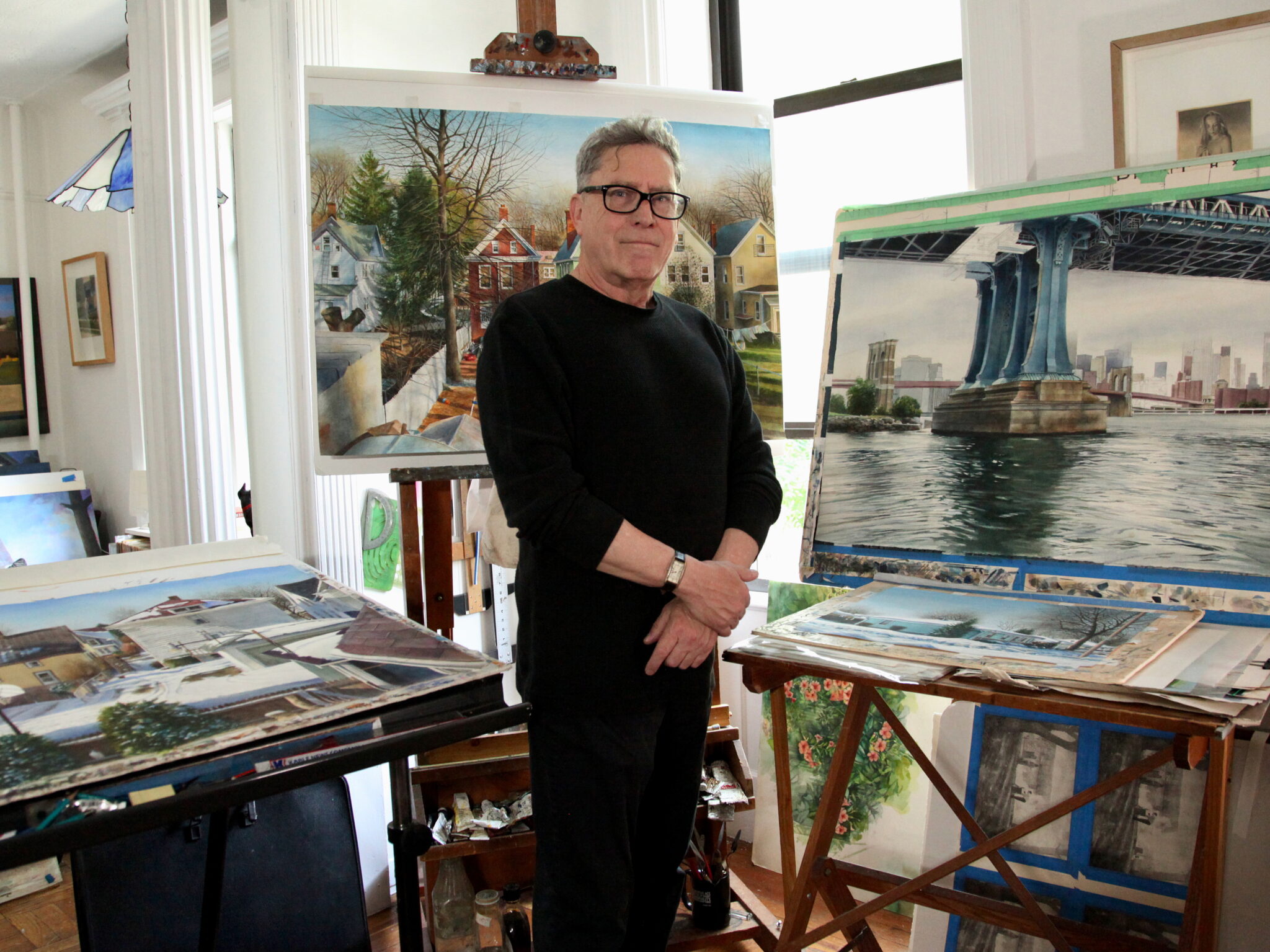
Showing more. I’ve been a bit under the radar for too long for a variety of reasons. I also want to spread the word that watercolor can be a medium every bit as serious as oil. While I’m equally proud of my work in all media, in which I work, I’ve always been primarily known for my watercolors. Upon seeing them, people often exclaim that they can’t be watercolor. Hearing that makes me feel that I’m doing something unique.
What is the best thing about art in the era of social media?
For some artists, it has brought success, sales, and established reputations. While I have not managed to achieve that via social media, I do treasure the virtual and real world friendships I’ve made with other artists and the exposure to hundreds of others whom the legacy art media never would have shown me in another era.
PATRICK KING (@patrickking123 | patrickking.org) will be teaching “Plein Air Watercolor in Central Park,” a two-day workshop on June 28 and 29, 2025.
Selection of stories, guides, and more from the League.
.svg)
.svg)

.svg)